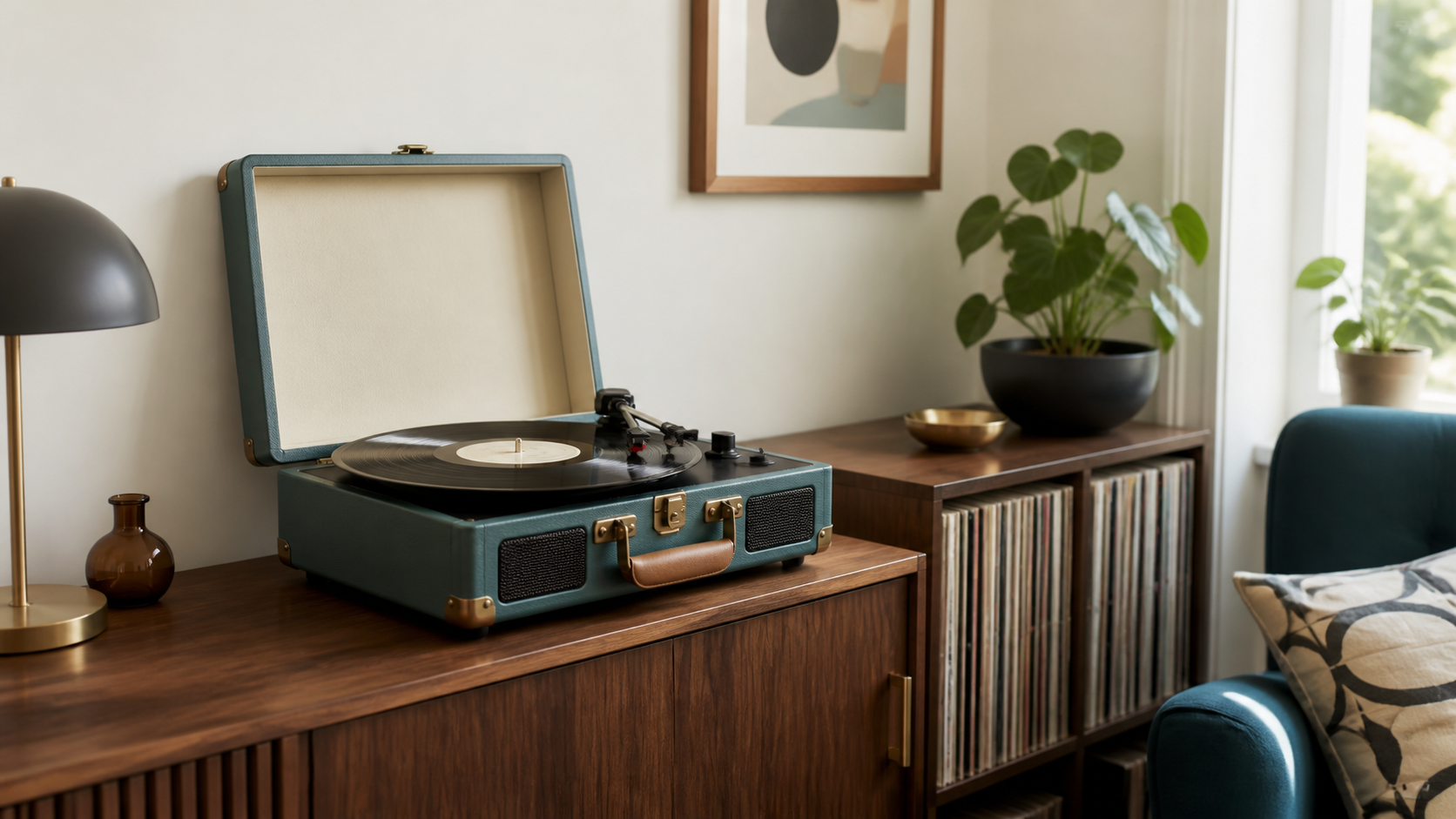
Retro-Style Record Players: A Practical UK Buyer's Guide
Choose a retro-style record player by drive, speeds, speakers, outputs and setup, not appearance alone. A practical UK guide for new vinyl buyers.
A retro-style record player can be a welcoming way into vinyl, but the cabinet colour and suitcase handle tell you very little about how it will play a record. The useful comparison starts underneath the styling: platter speeds, drive system, cartridge and stylus arrangement, speakers, outputs, Bluetooth direction and the setup the deck actually requires.
Choose the player for how you will listen, then choose the look. That one change of order prevents an attractive object from becoming the wrong audio system.
Decide what “all in one” must include
Some buyers want one box that plays records through built-in speakers. Others expect a turntable to connect to existing powered speakers, an amplifier or Bluetooth headphones. Those are different systems.
Write down the complete listening path:
Record to stylus to player electronics to the speakers or headphones I already own.
Then check every connection in that path. A product described as having Bluetooth may receive music from a phone, transmit record audio to a speaker, or do both. The word “Bluetooth” does not establish direction. Likewise, an RCA socket may be fixed line level, phono level or switchable. Confirm the manual or current listing rather than guessing from photographs.
Check the record speeds you need
For many modern collections, 33 1/3 and 45 rpm cover the common LP and single formats. Some older records require 78 rpm, but speed compatibility alone does not mean one stylus is appropriate for every record.
Make a small inventory before buying:
- How many 12-inch LPs do you have?
- Do you own 7-inch singles that need a centre adaptor?
- Are any discs marked 78 rpm?
- Are the records valuable, fragile or mainly casual listening copies?
The live Turnio product listing describes a three-speed player. Treat that as a seller-provided specification to verify on the current page and in the supplied instructions. If 78s matter to you, confirm the stylus requirement for the exact records and player rather than assuming that selecting the speed is the only change.
Understand the compromises of built-in speakers
Built-in speakers reduce the number of boxes and cables. That can be ideal in a bedroom, rented flat or first setup. The compromise is that a compact cabinet has limited space for speaker placement, and sound from the same enclosure can interact with the deck.
The right question is not whether built-in speakers are universally good or bad. Ask whether they are adequate for your room and whether the player gives you a sensible upgrade route.
| Listening need | Connection to look for |
|---|---|
| One-box casual listening | Built-in speakers with usable volume control |
| Existing powered speakers | Confirmed line-level output |
| Traditional amplifier with phono input | Correct phono-level output or a compatible switch setting |
| Wireless headphones or speaker | Bluetooth transmission, explicitly stated |
| Private wired listening | Headphone socket with the correct connector size |
If the manual does not make the signal level clear, ask before connecting equipment. Do not infer it from the shape of the socket.
Belt drive, tonearm and stylus: what to inspect
“Belt-driven” describes how the motor turns the platter. It is not, by itself, a verdict on sound quality. Build quality, speed stability, cartridge alignment, tracking force and the support beneath the player all contribute to performance.
Look for clear instructions on these points:
- How the platter and belt are fitted, if assembly is required.
- Whether tracking force is factory-set or user-adjustable.
- Whether anti-skate is present and how it is set.
- Which replacement stylus is specified.
- How the tonearm is secured for transport.
Official turntable manuals show why setup matters: the deck should be stable and level, and adjustable tracking force must be set according to the cartridge instructions. A generic internet setting is not a substitute for the actual manual.
If a player arrives with a transport screw, tie or stylus guard, follow the maker’s sequence. Never drag the stylus across a record or use the tonearm as a handle.
Put the player on proper furniture
A record player needs a firm, level surface. Avoid a flexible shelf, a wobbly table or furniture that also carries a speaker producing strong vibration. Leave room to open the lid fully and reach the controls without touching the tonearm.
Keep the power lead and audio cables clear of foot traffic. If you need an extension lead, use one correctly rated for the load, keep it undamaged and do not daisy-chain extensions. Electrical Safety First advises against overloading extension devices and recommends fully unwinding cable reels for their rated use.
A retro cabinet does not make old wiring safe. Stop using the product if a plug, lead or socket becomes hot, damaged or produces a burning smell, and seek competent help.
Bluetooth is a convenience feature, not a vinyl requirement
Bluetooth can make a compact system easier to place, but first establish what the implementation does.
- Bluetooth input lets the player act as a speaker for a phone or tablet.
- Bluetooth output sends the turntable’s audio to compatible wireless speakers or headphones.
- Some products offer both; some offer only one direction.
Wireless playback also adds another powered device and another volume control. If simplicity is the goal, test whether every intended listener can select the right mode and recover from a lost pairing without frustration.
For a permanent hi-fi connection, a wired output may be the more predictable route. That is a practical preference, not a claim that every Bluetooth implementation sounds the same.
Protect the records as well as the player
Dust and mishandling can spoil listening long before a specification becomes relevant. Hold records by the edges and labelled centre, return them to their sleeves and keep them upright away from heat. Use the cueing control where supplied rather than dropping the stylus by hand.
For a separate maintenance route, see the beginner’s guide to records and older collections. Cleaning advice should match the record and product involved; avoid household cleaners or improvised fluids that leave residue.
Replace a worn or damaged stylus with the exact compatible part. A seller saying that a stylus is “universal” is not enough evidence for a valuable collection.
Keep neighbouring guides distinct
This page answers how to choose a retro-styled player. It should not duplicate every related article.
- The all-in-one record player guide focuses on complete systems and connection trade-offs.
- The retro record player gift guide is for a buyer choosing for someone else, where returns and ease of use carry more weight.
- The older-record guide covers handling and collection needs.
Use these routes to answer the next decision rather than treating several titles as independent product endorsements.
Where the current Turnio model fits
The live Turnio vintage Bluetooth record player listing describes a three-speed walnut wood-grain player with built-in 5 W speakers, Bluetooth 5.4 input and RCA line out. Check the product page for the current specification.
It may fit a buyer who values compact one-box listening and a retro appearance, while wanting an output path for other speakers. Before ordering, verify the current manual, Bluetooth direction, included accessories, replacement stylus, dimensions and output level. Price and availability can change, so check the live listing rather than relying on a number preserved in an article.
Also read the current returns policy before discarding packaging. Basic fit and operation are easier to check while the player and its transport parts remain complete.
A five-minute pre-purchase check
- List the record speeds in your collection.
- Choose built-in, wired external or Bluetooth listening.
- Verify Bluetooth direction and wired output level.
- Confirm stylus replacement and setup instructions.
- Measure the furniture, including lid clearance.
- Read current delivery and return terms.
- Reject any listing that leaves a required connection ambiguous.
Frequently asked questions
Is a retro record player the same as a vintage record player?
Not necessarily. “Retro” commonly describes modern equipment styled to look older. A genuinely vintage player is older equipment whose electrical condition, cartridge and compatibility may need specialist assessment.
Do built-in speakers damage records?
That conclusion cannot be made from the phrase “built-in speakers” alone. The deck, tracking arrangement, enclosure and placement all matter. Set up the exact player according to its manual and keep it on a stable surface.
Can every Bluetooth record player connect to headphones?
No. Confirm that the product transmits audio over Bluetooth. A model with Bluetooth input only may accept music from a phone but not send record audio to headphones.
Can a three-speed player use one stylus for every record?
Do not assume so. Record format and groove requirements can differ. Follow the player and stylus maker’s compatibility guidance, particularly for 78 rpm records.
What should matter more than the colour?
The complete listening path, correct speeds, setup instructions, stylus support and a stable place to use the player. Once those are sound, choose the finish that suits your room.